AI SYSTEMS / LLM
LLM vs AI Model vs AI Agent vs AI Application
Understand the difference between AI models, large language models, agents, and complete AI applications, with practical examples.
 Vamshi KrishnaOctober 15, 2026 4 min read
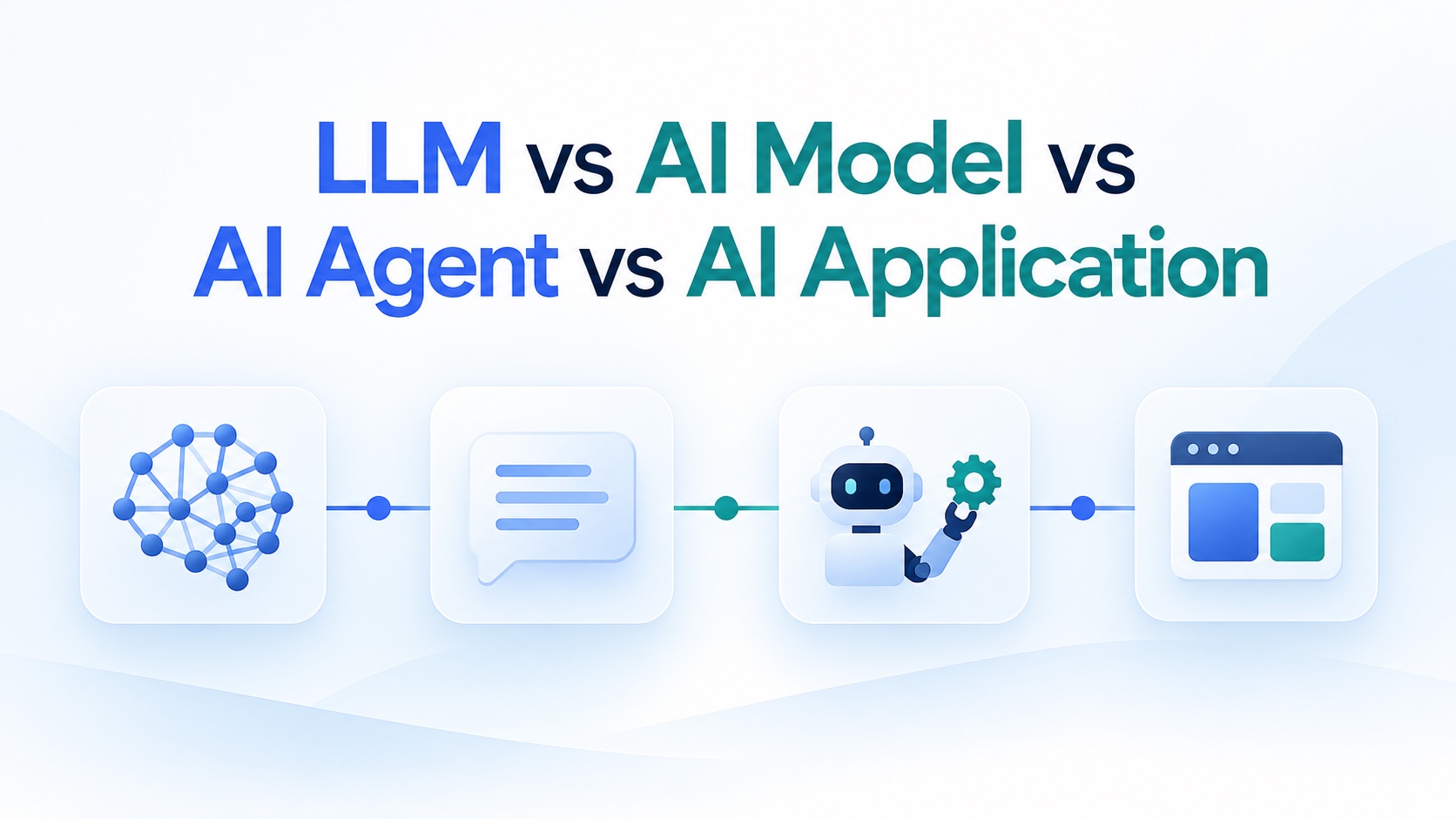
These terms are related, but they mean different things.
1. AI Model — The trained system
A model is a system trained to perform tasks using patterns learned from data. Depending on its design, it may work with text, images, audio, video, or other inputs.
Examples: GPT models, Qwen image models, Whisper speech recognition models.
2. LLM — The language specialist
An LLM (Large Language Model) is a type of AI model designed primarily to process and generate language. Modern LLMs can also reason, write code, and interpret supported non-text inputs.
Examples: GPT, Claude, Llama, Qwen language models.
3. AI Agent — The task executor
An agent uses a model to decide what to do, potentially calls tools, observes results, and takes further steps to achieve a goal.
Example: An agent that researches competitors, compares prices, and prepares a report.
4. AI Application — The complete product
This is the software people actually use. It can include a model, agents, a user interface, a database, payments, authentication, and other services.
Examples: ChatGPT, an AI chef app, or your own AI companion platform.
Remember this: An LLM is a type of model. An agent is a system that uses a model to pursue a goal. An application is the product that brings these components together.
2. How they work together
Let's say you want to build an AI personal assistant that can plan your day, send emails, and schedule meetings.
Your AI assistant app
The interface you interact with
LLM
Understands the request and plans possible steps
Agent logic
Chooses tools, executes steps, and checks results
Calendar API
Schedules meetings
Email API
Drafts or sends emails
The application connects these components and manages permissions and results.
Suppose you say:
"Schedule a meeting with Ravi tomorrow at 3 PM and send him an email."
The system might:
- Use the LLM to understand your request.
- Check your calendar for conflicts.
- Use the calendar tool to create the meeting.
- Draft an email and ask for your approval if required.
- Send the email through the email service.
- Tell you what happened.
The LLM doesn't magically send emails. The application must connect it to an email service and authorize that action.
3. What's the difference between a model and an agent?
This is one of the most important distinctions.
| Capability | LLM by itself | Agent system |
|---|---|---|
| Answer a question | Yes | Yes |
| Write code | Yes | Yes |
| Search the web | Only if provided a suitable tool or integration | Can use a search tool |
| Read your private database | Not automatically | Can retrieve data with permission |
| Send an email | No, not by itself | Can use an email API |
| Execute a multistep task | Can propose the steps | Can execute steps through connected tools |
| Check whether an action succeeded | Only with appropriate feedback | Can inspect tool results and continue |
An agent isn't necessarily a new or separate AI model. In many cases, it's an LLM surrounded by code that manages tools, state, permissions, and a loop of actions.
4. Different types of AI models
An LLM is just one category of AI model.
Language models
Understand and generate text, answer questions, and write code.
Examples: GPT, Claude, Llama, Qwen.
Vision models
Analyze images, recognize objects, and interpret visual content.
Examples: YOLO object detection models, vision-language models.
Image generation models
Create images from text prompts or reference images.
Examples: FLUX, Stable Diffusion, Qwen image-generation models.
Audio models
Transcribe speech, understand audio, or generate speech.
Examples: Whisper for speech recognition; text-to-speech models for voice generation.
Action and control models
Help systems select actions in environments, including robotics and simulations.
Examples: reinforcement-learning policies and robotics models.
Some modern models are multimodal, meaning a single model can handle multiple types of input or output, such as text, images, and audio.
5. What is the difference between GPT, Qwen, and Llama?
These are model families, not programming languages or agent frameworks.
| Name | What it is | How you commonly use it |
|---|---|---|
| GPT | OpenAI model family | Hosted products and APIs |
| Claude | Anthropic model family | Hosted products and APIs |
| Qwen | Alibaba model family | Hosted APIs or supported downloadable weights |
| Llama | Meta model family | Supported downloadable weights or hosted services |
| Gemma | Google model family | Supported downloadable weights or hosted services |
A model family may contain many different models with different sizes and capabilities. For example, a small coding model and a large multimodal model from the same family may have very different requirements.
NEXT IN THE SERIES
Keep building your understanding.
 Model landscape · 5 min readTypes of AI ModelsRead next