MODEL LANDSCAPE / LLM
Types of AI Models
A practical map of language, vision, audio, video, forecasting, recommendation, embedding, and other AI model categories.
 Vamshi KrishnaOctober 15, 2026 5 min read
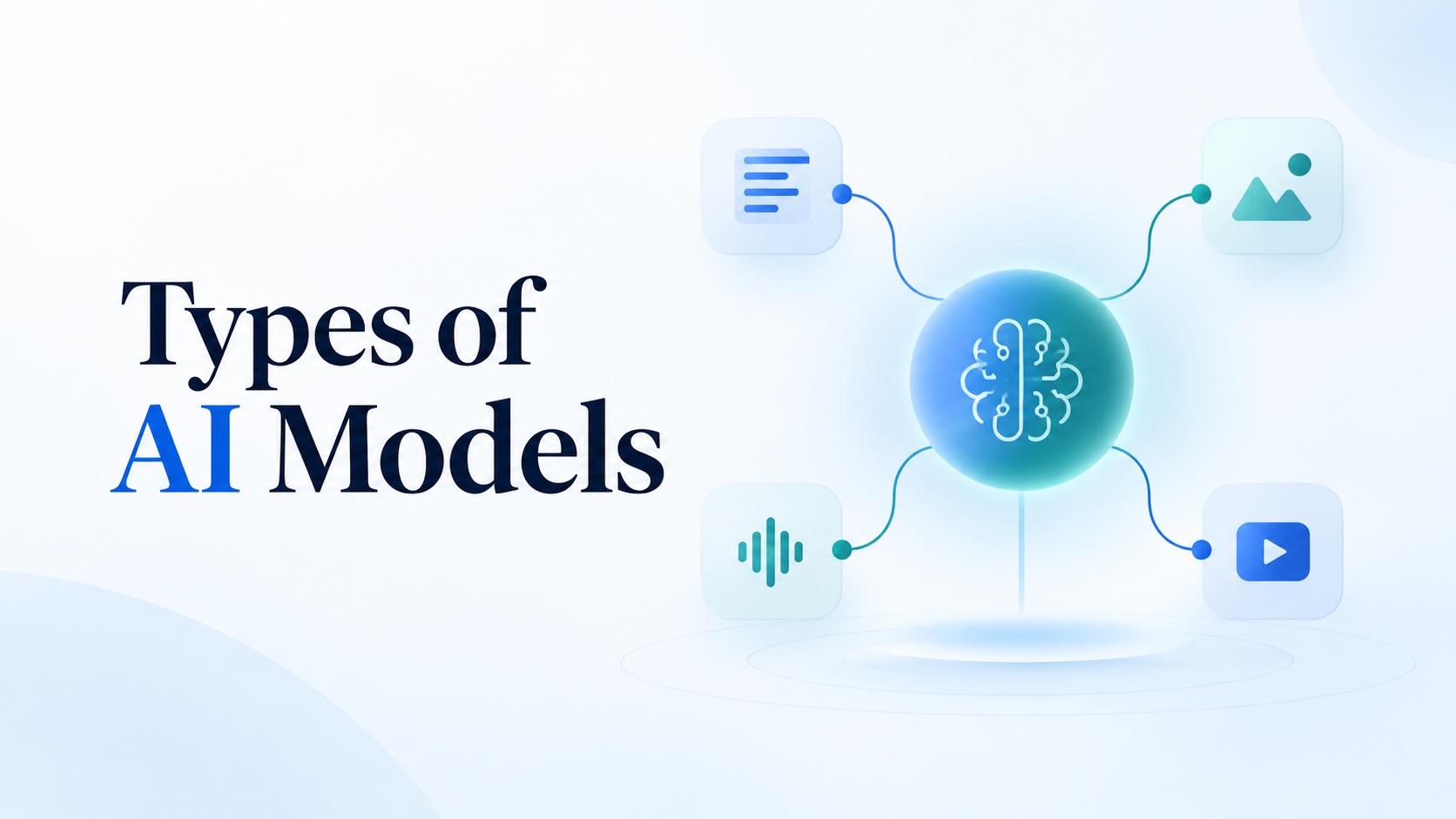
There are many more types of AI models than the five categories we discussed earlier. Those five were just a starting point.
The important thing to understand is that AI models can be classified by what they do, what data they process, and how they learn. These classifications overlap: one model can belong to several categories at once.
Let's build a bigger map of the AI model ecosystem.
1. The major categories of AI models
1. Language models
Understand and generate text, answer questions, write code, and solve problems.
Examples: GPT, Claude, Llama, Qwen.
2. Computer vision models
Analyze images and video to identify objects, people, scenes, and visual patterns.
Examples: YOLO object detection, image segmentation models, image classifiers.
3. Image generation models
Create or edit images from text prompts, reference images, or other inputs.
Examples: FLUX, Stable Diffusion.
4. Audio and speech models
Recognize speech, transcribe audio, understand sounds, and generate synthetic voices.
Examples: Whisper, text-to-speech models, speech-to-speech models.
5. Video models
Generate video, predict motion between frames, or analyze existing footage.
Examples: video diffusion models and video understanding models.
6. 3D and spatial models
Reconstruct 3D objects or environments, estimate depth, and represent geometry or spatial relationships.
Examples: NeRF, 3D Gaussian Splatting, depth-estimation models.
7. Robotics and action models
Help robots or software-controlled systems choose actions and interact with an environment.
Examples: robot control policies, vision-language-action models.
8. Prediction and forecasting models
Predict future values from historical data, such as demand, sales, energy use, or equipment failure.
Examples: time-series forecasting models, regression models.
9. Recommendation models
Predict what a user may want to watch, buy, read, or listen to.
Examples: collaborative filtering, recommendation ranking models.
10. Scientific and simulation models
Help researchers model complex systems in biology, chemistry, physics, and the environment.
Examples: AlphaFold for protein structure prediction; specialized weather and molecular models.
11. Anomaly detection models
Identify unusual patterns that may indicate fraud, cyberattacks, faulty equipment, or suspicious activity.
Examples: isolation forests, autoencoders, specialized fraud-detection models.
12. Embedding models
Convert text, images, audio, or other data into numerical representations that capture useful similarities and relationships.
Used for semantic search, document retrieval, recommendations, and RAG.
13. Graph models
Learn from entities and their relationships, represented as nodes and edges.
Examples: graph neural networks for fraud detection, molecule analysis, and network prediction.
14. Document intelligence models
Extract and interpret information from PDFs, forms, invoices, tables, and scanned documents.
Examples: OCR models, document layout models, document understanding models.
These 14 categories are a useful practical map, not an official or exhaustive taxonomy. There are many more specialized model types, and some fit into several categories.
2. More specialized AI models
Beyond those 14, here are additional categories you'll encounter when building AI products.
| Model category | What it does | Example use |
|---|---|---|
| Music generation | Creates music, melodies, or soundtracks | Generate a film score |
| Translation models | Translate between languages | Telugu to English translation |
| Classification models | Assign categories to inputs | Classify emails as spam or legitimate |
| Reranking models | Reorder search results by relevance | Find the most relevant script notes |
| Speech enhancement | Remove noise or improve speech quality | Clean audio recorded on a film set |
| Speaker recognition | Identify or verify a speaker's voice | Speaker diarization or voice verification |
| OCR and handwriting recognition | Read printed or handwritten text | Digitize handwritten notes |
| Segmentation models | Identify exact pixels belonging to objects | Separate a person from a background |
| Small language models | Perform language tasks with lower resource requirements | Run a lightweight assistant locally |
| World models | Learn representations of how environments change | Simulate possible future states for robotics |
| Reinforcement-learning policies | Learn which actions to take to maximize a reward | Control a robot or optimize a simulated task |
| Search and ranking models | Retrieve and rank relevant results | Product search and content discovery |
Some of these are separate model families; others are specialized tasks performed by models from broader families.
3. There's another way to classify AI: how models learn
This is a different classification from what we covered above.
A. Supervised learning
The model learns from examples paired with known answers.
Example: Feed it thousands of emails labeled "spam" or "not spam" so it learns to classify new emails.
B. Self-supervised learning
The model learns from patterns within the data itself, without requiring a human-provided label for every training example.
Example: An LLM learns to predict missing or subsequent tokens from large text datasets.
C. Unsupervised learning
The model discovers structure in data without explicit target labels.
Example: Group customers into clusters based on purchasing patterns.
D. Reinforcement learning
A system learns a policy for selecting actions using rewards or other feedback.
Example: Train an agent to complete a task in a simulated environment.
Modern systems can combine several learning methods. For instance, an LLM may be pretrained using self-supervised learning and then post-trained using supervised examples and preference-based or reinforcement-learning techniques.
4. The biggest concept: these categories overlap
Imagine an AI system that takes a Telugu screenplay and produces a cinematic video.
Telugu screenplay
Text input
Language model
Understands the story and generates a shot breakdown
Image and video models
Generate visual concepts and moving scenes
Audio models
Generate dialogue, voice, music, or sound effects
Complete filmmaking application
Coordinates the models, assets, and editing workflow
A single product can use multiple models. Likewise, one multimodal model may handle several tasks itself.
5. How to organize all of this in your mind
Think of AI models through three independent questions:
- What does it do? Language, image generation, prediction, recommendation, speech recognition, and so on.
- What does it work with? Text, images, audio, video, numerical data, graphs, or combinations of these.
- How does it learn? Supervised learning, self-supervised learning, unsupervised learning, reinforcement learning, or a combination.
NEXT IN THE SERIES
Keep building your understanding.
 Building blocks · 1 min readWhat Are APIs, Frameworks, and Hosting?Read next